

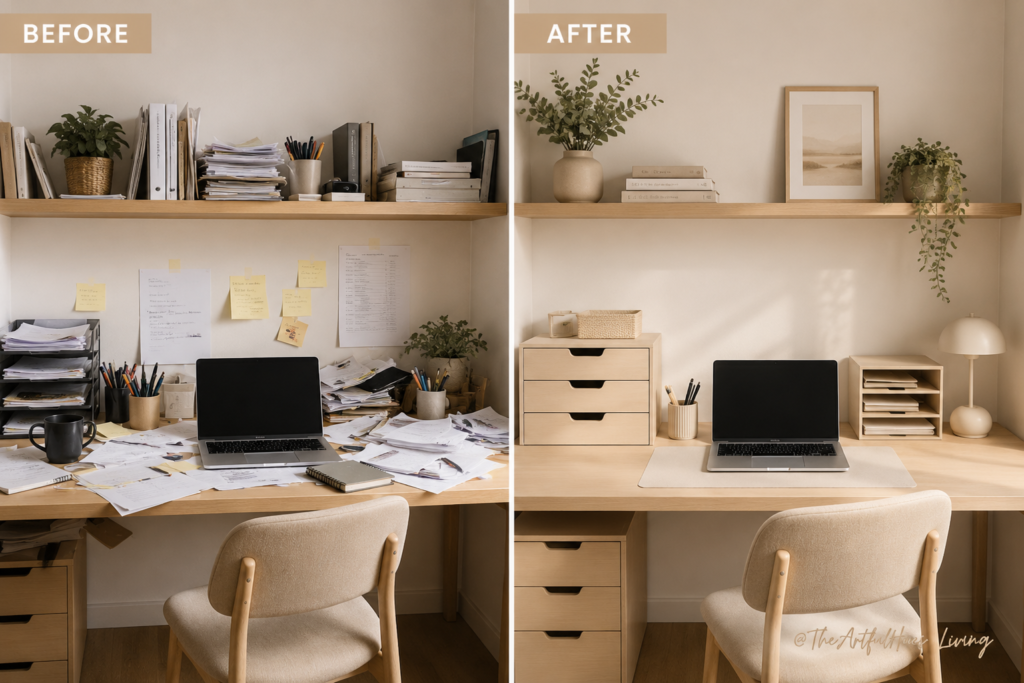
If you work from a compact desk, the right small desk storage ideas can make your space feel calmer, cleaner, and much easier to use. Whether you need better desk storage solutions, practical small home office storage, or simple desk organizer ideas, the goal is not to buy a bigger desk. It is to make every inch of your current desk work harder.
A small desk can quickly become messy because it has very little room for “temporary” clutter. One notebook turns into three. A few loose pens become a full pile of supplies. Bills, receipts, sticky notes, cables, and random paperwork slowly take over the surface.
The good news is that you do not need a full home office makeover to fix it. A few affordable storage products can help you create zones, clear your desktop, and make your workspace feel more intentional.
Disclosure: As an Amazon Associate, The Artful Hues may earn from qualifying purchases at no extra cost to you.
Why Small Desks Get Cluttered So Quickly
Small desks do not usually fail because they are too small. They fail because everything is stored in the wrong place.
When the desktop becomes the storage area, your working space disappears. Papers sit beside your laptop. Pens roll around the surface. Chargers get tangled. Receipts get pushed into corners. Before long, the desk feels stressful before you even start working.
A better approach is to divide your desk into three simple storage zones:
First, keep daily-use items within reach. These are things like pens, notebooks, sticky notes, and your planner.
Second, move occasional-use items off the main surface. These might include spare stationery, extra cables, folders, and paperwork.
Third, create a proper paper system. Bills, documents, receipts, and work papers need a place to go instead of sitting in random piles.
These small desk storage ideas are designed around that simple system.
1. Use Desktop Drawers to Hide Loose Office Supplies
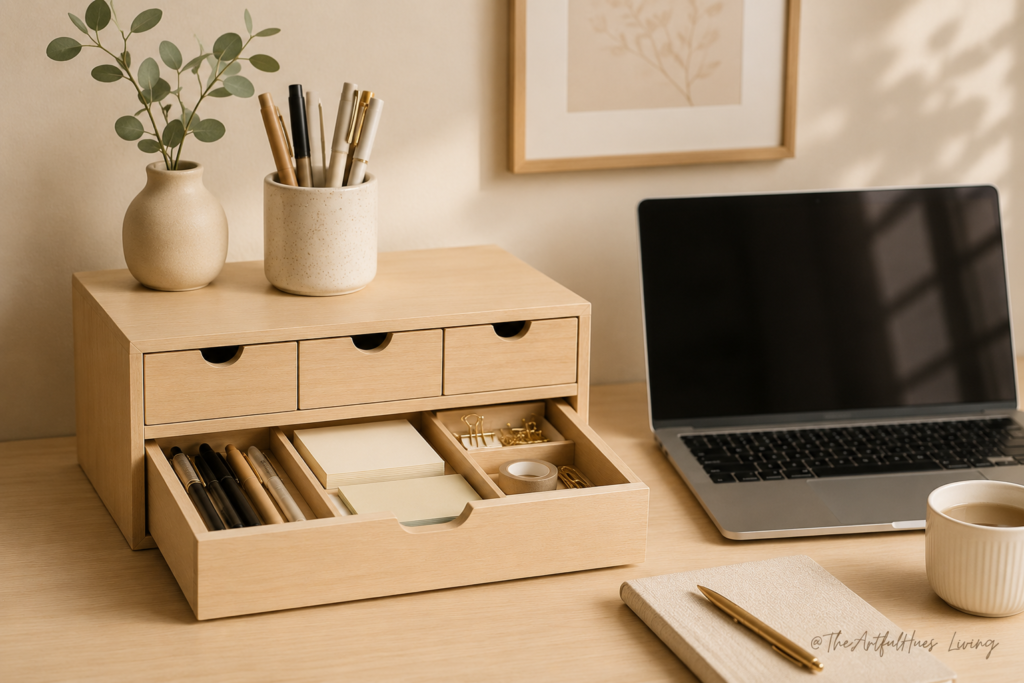
Desktop drawers are one of the easiest ways to make a small desk look instantly cleaner. They sit on top of your desk but keep small items hidden instead of scattered across the surface.
They are useful for pens, sticky notes, paper clips, charging cables, notepads, correction tape, highlighters, and other small office supplies. Instead of using a cup, tray, and random corner of the desk, you can place everything into one compact drawer unit.
For a small home office, look for desktop drawers with a slim profile. Clear acrylic drawers are useful if you like seeing what is inside. Neutral or wooden drawers work well if you prefer a softer, more styled workspace.
Best for: pens, sticky notes, small stationery, USB drives, and extra cables.
Helpful Amazon product idea: compact desktop drawer organizer, acrylic desk drawer unit, or small wooden desk organizer with drawers.
2. Add Stackable Trays for Papers You Still Need
Paper clutter is one of the biggest problems on a small desk. The issue is not always having too much paper. The problem is that every paper looks equally urgent when it is lying flat on your desk.
Stackable trays help by organising papers vertically. You can create simple categories such as “to action,” “to file,” and “to review.” This keeps paperwork visible without letting it spread across the whole desk.
For a tiny desk, choose trays that stack upward instead of spreading sideways. A two-tier or three-tier paper tray can hold notebooks, documents, mail, and printed forms while taking up a small footprint.
This is especially useful if you work from home and need to separate work papers from household papers.
Best for: active paperwork, notebooks, forms, letters, and printed checklists.
Helpful Amazon product idea: stackable letter trays, metal paper trays, or slim vertical desk trays.
3. Use a File Sorter for Documents You Reach for Often
A file sorter is different from a paper tray because it keeps documents upright and easier to flip through. This makes it ideal for papers you use regularly, such as client notes, current projects, tax reminders, bills to pay, or school documents.
If your desk is small, avoid wide file holders that take over the surface. A slim vertical file sorter can sit at the back corner of your desk and keep important papers easy to find.
You can also use file sorters for notebooks, planners, and folders. This is a simple way to stop notebooks from piling on top of each other.
Best for: folders, current documents, planners, notebooks, and reference papers.
Helpful Amazon product idea: vertical file sorter, mesh desktop file organiser, or wooden file holder.
4. Place a Rolling Cart Beside the Desk
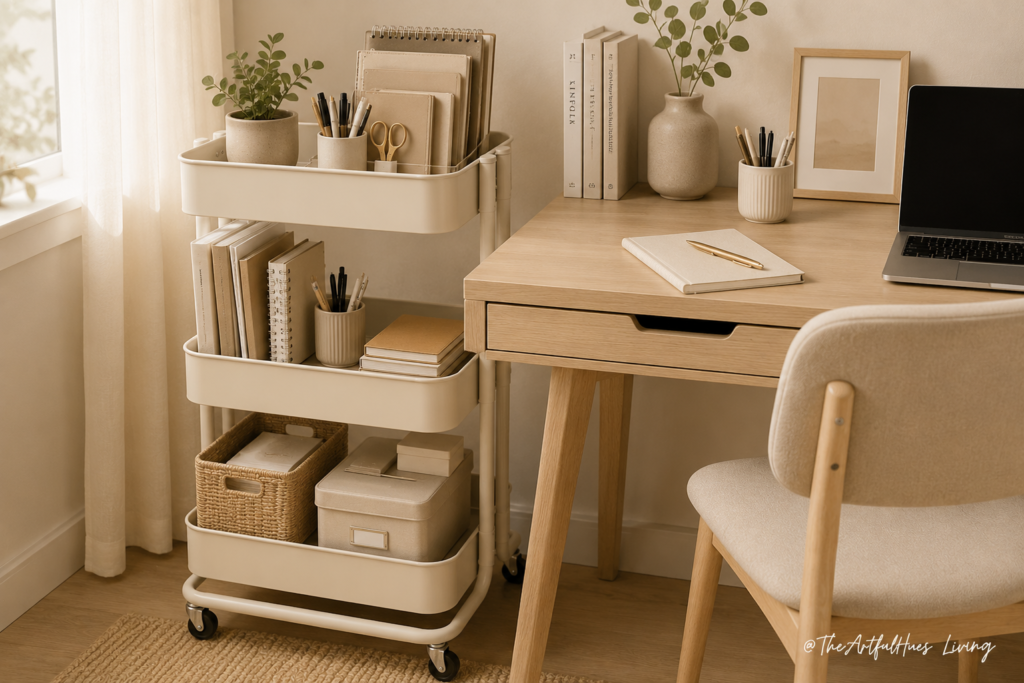
A rolling cart is one of the most practical desk storage solutions if your desk has little or no drawer space. It gives you extra storage beside your desk without making the desktop crowded.
The best part is that it is flexible. You can roll it closer while working and move it away when you want the space to look cleaner. A three-tier rolling cart can hold stationery, notebooks, folders, printer paper, craft supplies, tech accessories, and even a small basket for cables.
For a stylish home office, choose a rolling cart in white, beige, black, or soft neutral tones so it blends into your workspace.
Use the top tier for items you reach for daily. Use the middle tier for paperwork or notebooks. Use the bottom tier for bulkier items like extra paper, supplies, or storage boxes.
Best for: small offices with no drawers, shared workspaces, craft supplies, and extra stationery.
Helpful Amazon product idea: three-tier rolling cart, slim rolling storage trolley, or small office cart.
5. Install an Under-Desk Drawer for Hidden Storage
If your desk has no drawers, an under-desk drawer can be a smart upgrade. It attaches underneath the desk and adds storage without using any desktop space.
This is ideal for very small desks because it keeps the surface clear. You can use it for pens, sticky notes, charging cables, earbuds, small notebooks, and other everyday items.
Before buying one, check the underside of your desk. Some under-desk drawers use adhesive, while others need screws. Adhesive drawers are easier to install, but screw-in options may hold more weight.
This is one of the best small desk storage ideas if you want your desk to look minimal but still keep essentials nearby.
Best for: small stationery, chargers, earbuds, sticky notes, and daily essentials.
Helpful Amazon product idea: adhesive under-desk drawer, slide-out desk drawer, or hidden desk storage tray.
6. Use Wall Pockets to Free Up the Desktop
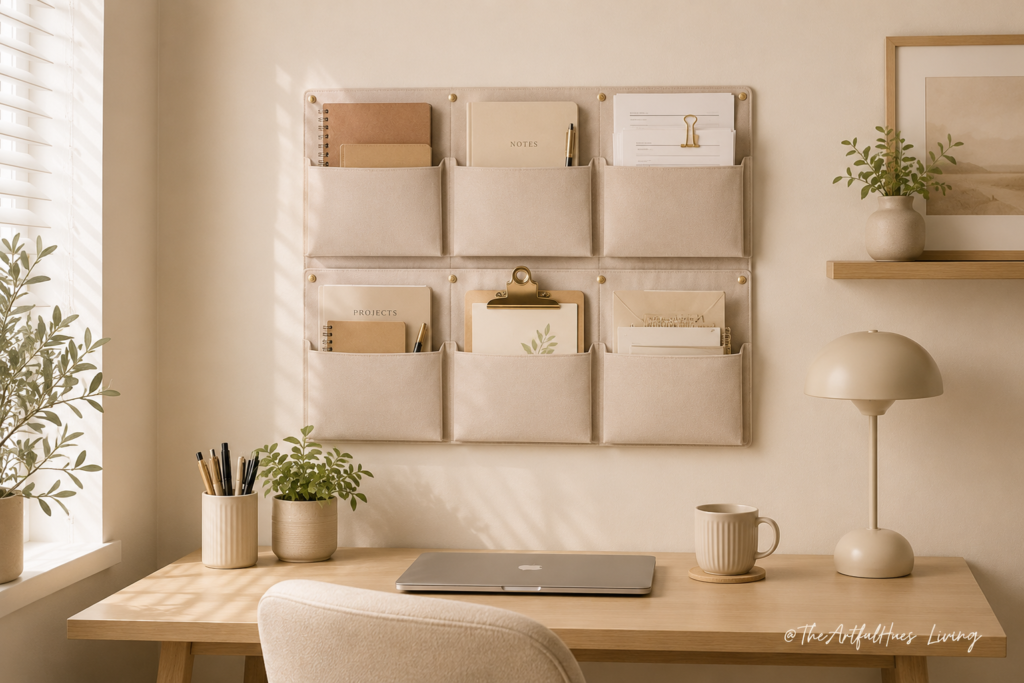
When your desk is small, the wall becomes valuable storage space. Wall pockets are perfect for using vertical space without adding another item to your desktop.
You can hang wall pockets above your desk or beside it to store documents, notebooks, folders, mail, and small papers. This keeps your main work surface clear while still making everything easy to reach.
For a softer home office look, choose wall pockets, neutral hanging organisers, or wooden wall-mounted file holders. If you prefer something more practical, clear wall pockets make it easy to see what is inside.
This is especially useful in apartments, small bedrooms, or shared spaces where you cannot fit a large filing cabinet.
Best for: documents, mail, folders, notebooks, and paper categories.
Helpful Amazon product idea: wall file organiser, hanging wall pockets, or wall-mounted document holder.
7. Add Drawer Dividers to Stop Small Items Mixing Together
If you already have a desk drawer, drawer dividers can make a huge difference. A drawer without dividers often becomes a messy “junk drawer” where everything gets thrown in together.
Drawer dividers help separate pens, clips, sticky notes, batteries, USB drives, labels, cables, and other small items. This makes it much easier to find what you need quickly.
Adjustable dividers are useful because you can customise the size of each section. Small plastic trays also work well if you prefer removable compartments.
This is a low-cost storage idea, but it can make your desk feel much more organised.
Best for: stationery, small tech items, clips, labels, sticky notes, and office supplies.
Helpful Amazon product idea: adjustable drawer dividers, bamboo drawer organiser, or plastic drawer storage trays.
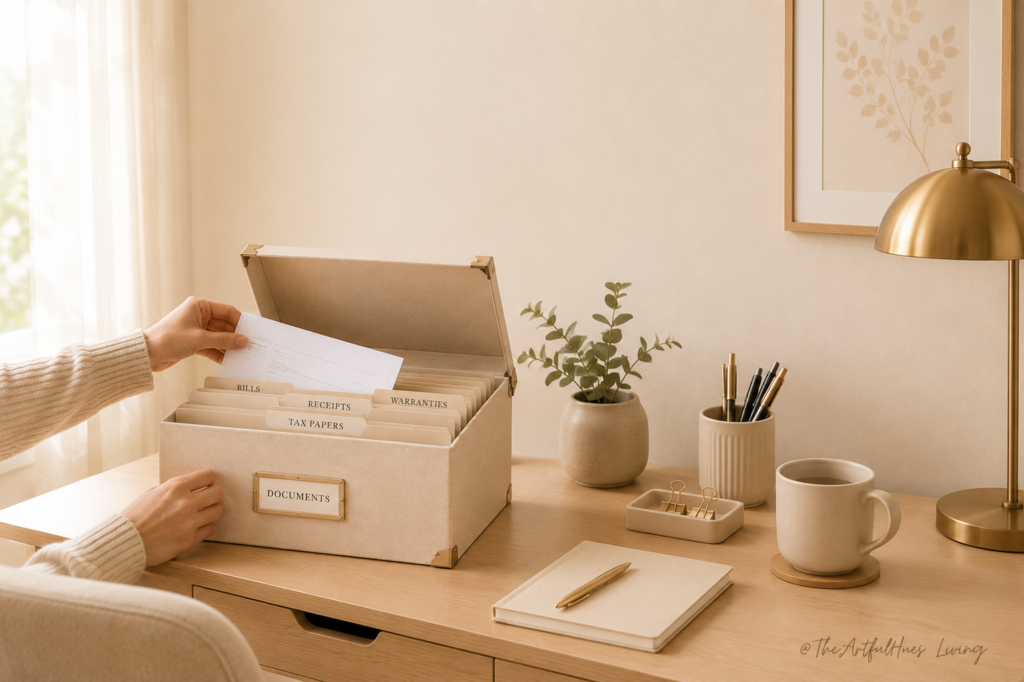
8. Store Bills and Receipts in a Document Box
Not every paper needs to sit on your desk. Bills, receipts, warranties, tax papers, manuals, and older documents should be stored somewhere separate.
A document box is a simple way to keep these papers organised without using desk space. Choose one with tabs or folders so you can create categories such as receipts, bills, home, tax, work, and warranties.
This is especially helpful if your desk tends to collect household paperwork. Instead of leaving papers in a pile, you can place them into the right section once or twice a week.
A document box also makes your workspace feel lighter because you are not visually reminded of every life admin task while you are trying to work.
Best for: bills, receipts, warranties, manuals, tax papers, and household documents.
Helpful Amazon product idea: expanding file box, portable document organiser, or accordion file folder.
9. Create a Daily Desk Caddy for Items You Use Every Day
A small desk caddy can keep your daily essentials in one place. This works well if you like having items nearby but do not want them spread across the desk.
Use a caddy for your favourite pens, notepad, sticky notes, scissors, ruler, hand cream, glasses, or small planner. The key is to keep it limited to items you genuinely use often.
A desk caddy is also useful if your workspace is temporary. For example, if you work at the dining table or in a shared area, you can pick up the caddy and move everything at once.
Best for: daily office supplies, portable work setups, and shared home offices.
Helpful Amazon product idea: desktop caddy organiser, pen holder with compartments, or portable office supply organiser.
10. Use Small Storage Bins for Backstock Supplies
Small desks often become cluttered because backup supplies are stored too close to the work area. Extra pens, printer paper, notebooks, cables, and sticky notes do not need to live on the desk.
Use small storage bins or lidded boxes to store these items nearby but out of sight. You can place them on a shelf, inside a cupboard, under the desk, or on the bottom shelf of a rolling cart.
This helps you keep your desk for active work, not storage overflow.
Choose bins that are easy to label. Even simple labels like “stationery,” “paper,” “cables,” and “receipts” can make your home office easier to maintain.
Best for: extra supplies, backup stationery, cables, notebooks, and office refills.
Helpful Amazon product idea: small lidded storage bins, labelled office storage boxes, or fabric storage baskets.
How to Choose the Best Storage for Your Small Desk
Before buying anything, look at what is actually cluttering your desk.
If your problem is paper, start with stackable trays, a file sorter, wall pockets, or a document box.
If your problem is small supplies, choose desktop drawers, drawer dividers, or a desk caddy.
If your problem is lack of space, try an under-desk drawer, rolling cart, or wall storage.
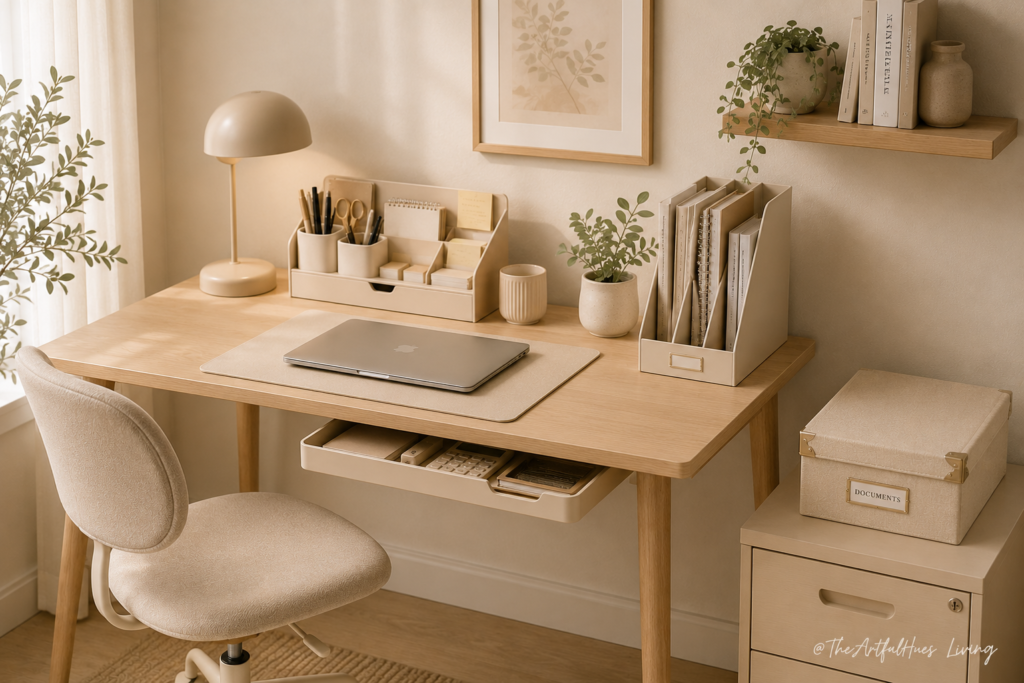
You do not need all ten ideas at once. Start with the storage product that solves your biggest problem first. For many small desks, the best starting combination is a desktop drawer, stackable paper tray, and document box.
That gives you a place for small items, active papers, and long-term paperwork.
Final Thoughts
A small desk can still feel calm, functional, and organised when every item has a proper place. The goal is not to hide everything perfectly. The goal is to make your workspace easier to use every day.
Start with one clutter category: papers, stationery, documents, or extra supplies. Then choose the storage solution that fixes that problem directly.
With the right small desk storage ideas, even a tiny workspace can feel more spacious, focused, and easier to maintain.
Happy organising.
For more small home office and desk organization inspiration, follow us at The Artful Hues on Pinterest.